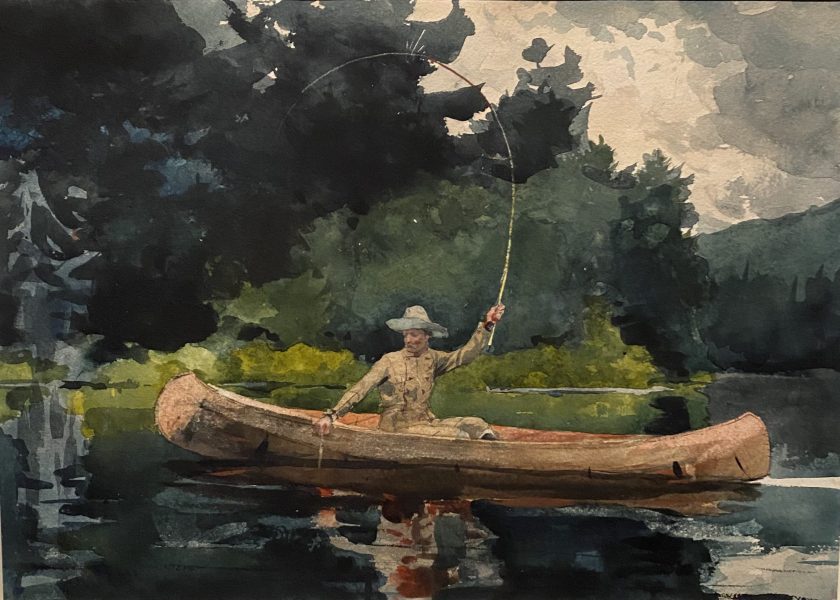
Standing in the dark gallery filled with a sea of people, I struggle to get a close up view of the iconic watercolor paintings by Winslow Homer on display at the Museum of Fine Arts, in Boston. It is a stunning show of works, some of which have not been seen for decades. I love coming to the exhibitions. The abundant displays of art from all over the world inspire awe and inspiration for the many visitors that pass through the museum’s doors. And yes, for me as well. Yet the place that really ignites my imagination is in the artist’s studio. Where the quiet chaos slowly unfolds into the masterpieces that line the walls in these great galleries.
I delight in the smell of linseed oil and turpentine, mixed with fresh oil paint. And if I close my eyes I can still hear the faint sound of the old wood plank floors creaking underfoot, as I walked across my former high school art studio. It alway seemed dark and moody in there, steeped in the quiet turmoil of creativity. But what exactly makes a great piece of art? Why does one painting or work of art draw millions of visitors per year, yet another, perhaps even by the same artist… well, crickets.
I recently read this question in a magazine article. And although they had a few interesting ideas, they never really gave an answer. So, I decided to explore this notion for myself, starting with what I already know about artistic creators.
They are innovators, movers and shakers and ahead of their time. They see things differently, and the stories behind those works of art can be fascinating. Artist are not afraid to think outside the box. In fact, they were born to think outside the box.
Consider Elisabeth Vigee Le Brun. Not only was she a successful female artist in 18th century France, almost unheard of at the time, but she also seemed to be the mother of photoshop. Centuries before we were image editing our photos, she was using her gift of flattery to portray her clients in a more visually pleasing way. Shortening a nose here, strengthening a weak chin there and basically using her paintbrush to refine her patrons’ essences.
Or Caravaggio, the rebellious Italian painter from the 1500’s, with his inventive use of light and dark to create dramatic intensity. And his notorious use of ordinary people, to elevate the scenes of everyday life to canvas worthy masterpieces.
And who can forget Monet, the father of impressionism, and his revolutionary use of light and color? Or Van Gogh’s brush stroke portrayal of deeply displayed emotions?
Still, what makes one work of art more memorable than another? What is it that captures our attention and catapults it to fame? I believe it is the story. Behind every work of art there is a story, whether we consciously know it or not, we feel it. We recognize it. It moves us. Some profoundly more than others.
Since the beginning of time, humans have loved stories. Long before the written word ever existed, they were passed down orally generation to generation. Maybe around a campfire, or visually pictured on ancient cave walls. We learn from them, we are entertained by them, we cry and grow with them. They are as much apart of our lives as living. They are life.
And though I am no expert or art historian, for me that is just it. Artists take us on a journey with them, transporting us into the stories that they create. Is that a smile on Mona Lisa’s face, why is she looking so directly at us? Was that really the way the night sky swirled in 19th century France, or did Van Gogh just have a little too much wine with dinner that night? We are hooked. We are mesmerized. And then they leave us hanging, because we never truly know what the answer is or what the ending is supposed to be… That is solely up to our “artistic interpretation”. Because as with art and life, the finale is uniquely our own creation.
 Elemental Energies