No Yelling, Please!

Photo by BOOM ud83dudca5 Photography on Pexels.com

I love Lindsay Gibson. Anytime I get to listen to a guest interview with her, I jump at the chance. She is a clinical psychologist and author of several books on emotional immaturity, including her bestseller, Adult Children of Emotionally Immature Parents. This time, though, Lindsey was talking about her new book – How To Raise An Emotionally Mature Child. And as usual, she did not disappoint!

However, even though I really resonate with her thoughtful commentary and wise advise on emotional immaturity, there was one little sticking point that caught my attention during this interview. And I wasn’t the only one. All in the Mind podcast presenter, Sana Qadar struggled with it too. In fact, she admitted that it made her a little angry. Because, she’s done it, I know I’ve done it, and I am pretty sure everyone else has done it too.

In her new book, Lindsay lists several basic mindsets that contribute to raising an emotionally healthy child. Such as, your child has their own unique personality, emotional needs and their behavior is the way they are communicating those needs. All reasonably valid points, to which most parents would agree.

Then there are the absolutes. Behaviors that parents should absolutely avoid in order to help build emotional maturity in their children. Go with guidance rather that punishment. No hitting. Don’t berate or humiliate your child, to name a few, but then comes “Yelling is for emergencies only” – “wait, WHAT!” Sana exclaimed, “that one made me a little angry.”

Me too, not angry, exactly but shaking my head. Define emergency, Lindsay. Because when you are trying to get out of the house for an appointment and your kid is drawing all over your brick fireplace with crayons, or when your husband leaves the paint roller in the sink and your 17 month old grabs it and starts painting the floor of your new house in Benjamin Moore revere pewter, Yelling Happens! Just saying.

Does yelling mean we have failed as parents or at the very least, we’re doing parenting all wrong? Sure we should avoid it, but in those stressful moments, emotional regulation kind of goes out the window! But in her defense, Lindsay did say that we’ve all done it.

And we have definitely evolved. As Lindsay reminds us, past generations of the 40’s and 50’s were mainly concentrating on being properly authoritative for their children and just keeping a roof over their heads. Their emotional needs were certainly not being considered as much. Back then, everyone spanked and yelled at their kids. But there was also a lot of love and kindness in most of those families as well.

Even in the mid 60’s and early 70’s it was common to hit your kids. And not only was it the cultural norm but parents did it with what ever they could find, a wooden spoon from the kitchen drawer, or maybe a spatula. In fact, some folks even bought wooden paddle balls and let their kids play with them until the string broke, and then would use it for a spanking paddle. Think about that one for a minute or two. I just wonder what Lindsay would have to say about it now!

Of course, it was the 60’s after all, and no one really thought too much about it, because it was the cultural standard of the time. Most of those people were good, kind and loving parents. They were just following the norm, which thankfully, is no longer the norm. If fact, it was probably that generation of kids who changed the rules!

But yelling? …. Ehhh, I’m still having a bit of trouble with that one. I mean, I get that we shouldn’t do it, but in the heat of the moment it’s probably going to happen. And if it does get to that point, perhaps we should reflect on how we can do things differently. As Sana Qadar said, “I did go home and game plan: what else could I do in the morning?” And as annoying and unrealistic as she thought the advice was, thinking more deeply about what she could do otherwise, did work.

I do have a question for Lindsay, though. Do those same rules apply for spouses? Because if so, I have done a terrible job at raising mine! Maybe be your next book could be on how to raise an emotionally mature partner!

The Goal Is To Become

Photo by ADP

“It was so overwhelming,” I sighed, to my friend Maria on the phone, as I recounted my recent trip to my daughter’s newly leased campus apartment. “The bathroom looked like it hadn’t seen a sponge or a bottle of Fantastik in years!”

“That does sounds a bit daunting,” Maria agreed, “How long did it take to scrub it all down?”
“Hours!” I groaned. “It was such a big task that I could only focus on one piece of the job at a time.”

“I feel the same way about my goals,” Maria mused. “It sometimes feels like I am never going to be able to achieve them.” I agreed, as I thought about how may times I start out excited about a new project, only to let it fizzle out halfway through. 

I like to think of my goals as the stars of the show, the end point I want to get to. They’re always so bright and sparkly… and very far away. But what I have learned over time is that goals are not a singular thing, they are a part of a process. And all the steps in-between are a set of processes that lead to the final outcome. 

Those steps in-between are where the real magic happens, where our stories begin to unfold and take shape. And like a beautiful garden, they take time to cultivate and need to be pruned along the way. Which means that as much as I want to get to that end point, they simply can not be rushed.

Often, I find that if I am struggling with those steps, some questions start to emerge. Author and podcaster, Forrest Hanson, suggests “focusing on the real end goal that you’re trying to reach. What is your why?” Because sometimes we may find that we did not write it for ourselves or that our expectations are unclear. Do you really want to wake up early to train for that that 5k run with your friend, or would you rather go for a morning walk with them instead? 

It can be daunting when our goals seem unrealistic or too far out of reach. Those are the ones that need to be reassessed and pruned. Perhaps it’s better to focus on smaller targets, like starting with a blog instead of writing a novel! It can be difficult to let go of a dream, but refining it keeps it within reach. 

Sometimes the goal is just to push through as fast as possible, like cleaning the bathroom in my daughters new apartment. I intensely wanted to get it done. But I have learned to be consistent rather than intense. Passion burns out, consistency remains. I may not have been thrilled, but as I steadily continued to clean, I felt energized as each small task was complete. Gradually, what seemed like an insurmountable goal, began to feel obtainable.

And yeah, some goals are going to fail, we’re not going to cross every finish line. But those are the ones that usually teach us valuable lessons. The ones that shape us and become part of our ever evolving story. 

But no matter how much we prune and refine, if we don’t create an environment to thrive, we probably won’t succeed. Because it will take discipline, consistency, joy and strength. And above all else, community. 

As author and keynote speaker, James Clear once said, “The goal is not to finish the painting, the goal is to become an artist.” And the in-between steps are the becoming. Where life is lived and our stories unfold. Because that’s where the real magic happens.

Painting Outside The Box

Photo by ADP – Winslow Homer Exhibit MFA Boston

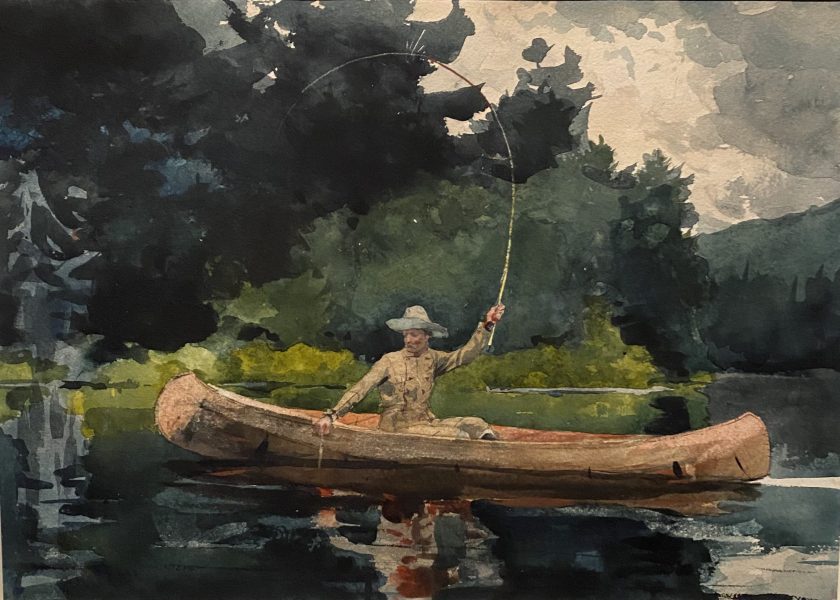
Standing in the dark gallery filled with a sea of people, I struggle to get a close up view of the iconic watercolor paintings by Winslow Homer on display at the Museum of Fine Arts, in Boston. It is a stunning show of works, some of which have not been seen for decades. I love coming to the exhibitions. The abundant displays of art from all over the world inspire awe and inspiration for the many visitors that pass through the museum’s doors. And yes, for me as well. Yet the place that really ignites my imagination is in the artist’s studio. Where the quiet chaos slowly unfolds into the masterpieces that line the walls in these great galleries.

I delight in the smell of linseed oil and turpentine, mixed with fresh oil paint. And if I close my eyes I can still hear the faint sound of the old wood plank floors creaking underfoot, as I walked across my former high school art studio. It alway seemed dark and moody in there, steeped in the quiet turmoil of creativity. But what exactly makes a great piece of art? Why does one painting or work of art draw millions of visitors per year, yet another, perhaps even by the same artist… well, crickets.

I recently read this question in a magazine article. And although they had a few interesting ideas, they never really gave an answer. So, I decided to explore this notion for myself, starting with what I already know about artistic creators.

They are innovators, movers and shakers and ahead of their time. They see things differently, and the stories behind those works of art can be fascinating. Artist are not afraid to think outside the box. In fact, they were born to think outside the box.

Consider Elisabeth Vigee Le Brun. Not only was she a successful female artist in 18th century France, almost unheard of at the time, but she also seemed to be the mother of photoshop. Centuries before we were image editing our photos, she was using her gift of flattery to portray her clients in a more visually pleasing way. Shortening a nose here, strengthening a weak chin there and basically using her paintbrush to refine her patrons’ essences.

Or Caravaggio, the rebellious Italian painter from the 1500’s, with his inventive use of light and dark to create dramatic intensity. And his notorious use of ordinary people, to elevate the scenes of everyday life to canvas worthy masterpieces.

And who can forget Monet, the father of impressionism, and his revolutionary use of light and color? Or Van Gogh’s brush stroke portrayal of deeply displayed emotions?

Still, what makes one work of art more memorable than another? What is it that captures our attention and catapults it to fame? I believe it is the story. Behind every work of art there is a story, whether we consciously know it or not, we feel it. We recognize it. It moves us. Some profoundly more than others.

Since the beginning of time, humans have loved stories. Long before the written word ever existed, they were passed down orally generation to generation. Maybe around a campfire, or visually pictured on ancient cave walls. We learn from them, we are entertained by them, we cry and grow with them. They are as much apart of our lives as living. They are life.

And though I am no expert or art historian, for me that is just it. Artists take us on a journey with them, transporting us into the stories that they create. Is that a smile on Mona Lisa’s face, why is she looking so directly at us? Was that really the way the night sky swirled in 19th century France, or did Van Gogh just have a little too much wine with dinner that night? We are hooked. We are mesmerized. And then they leave us hanging, because we never truly know what the answer is or what the ending is supposed to be… That is solely up to our “artistic interpretation”. Because as with art and life, the finale is uniquely our own creation.

Green Bean And Lamb Stew

Photo by ADP

Lately, now that I have more time on my hands, I find myself in the kitchen a lot. Cooking has become like art to me, well, it is an art actually. I have become so curious that I find myself browsing though cookbooks in bookstores, and scanning food magazines while I wait in the grocery line. I’ve even taken up listening to a new podcast all about the science and history of food.

And though I may have been feeling the pull toward the culinary arts gradually, I realized that it wasn’t so new. I had always been interested in some form of cooking as far back as grade school. I remember being in my childhood kitchen trying to recreate a recipe for chip dip, that my mother had served at a party a few nights before. Diligently working to combining Miracle Whip with salt, pepper and any other spices I could find. Then there was the cake decorating class I took in the seventh grade, and the time I eagerly convinced my mother to teach me how to make her homemade macaroni and potato salads as a teenager.

I had somehow missed the fact that it wasn’t just the fine arts that intrigued me, but cooking as well. I like the idea of creating little edible masterpieces every time I’m in the kitchen. However, that being said, it has to be easy and it has to be fun. If it is a long drawn out process, recipes that take a great deal of time or are too complicated, I am kind of out. I’ll leave those to my husband!

Mostly it is just me having some fun, playing around and learning what works and what doesn’t. Purely everyday sort of stuff. Until, I got inspired by my favorite food podcast to try something a little more challenging. 

After listen to an episode about the history of Chinese American food, I decided to dig a little deeper into my own ancestry and find out what culinary delights it might have to offer. Being a mixture of Irish, Scottish, Canadian and Lebanese it was hard to pick. But since I have always loved Italian food, I decided to go with the Mediterranean side. So, Lebanese it was.

As I explored the rich history of mediterranean food, I stumbled on Maureen Abood and her classic Lebanese Mediterranean cuisine. Perfect, I thought! And as I scrolled through her collection of recipes, it brought back fond memories of the “Syrian food” my Lebanese grandfather and his siblings used to bring to our family gathering on special occasions. The stuffed grape leaves, the Syrian bread, it was all so good!

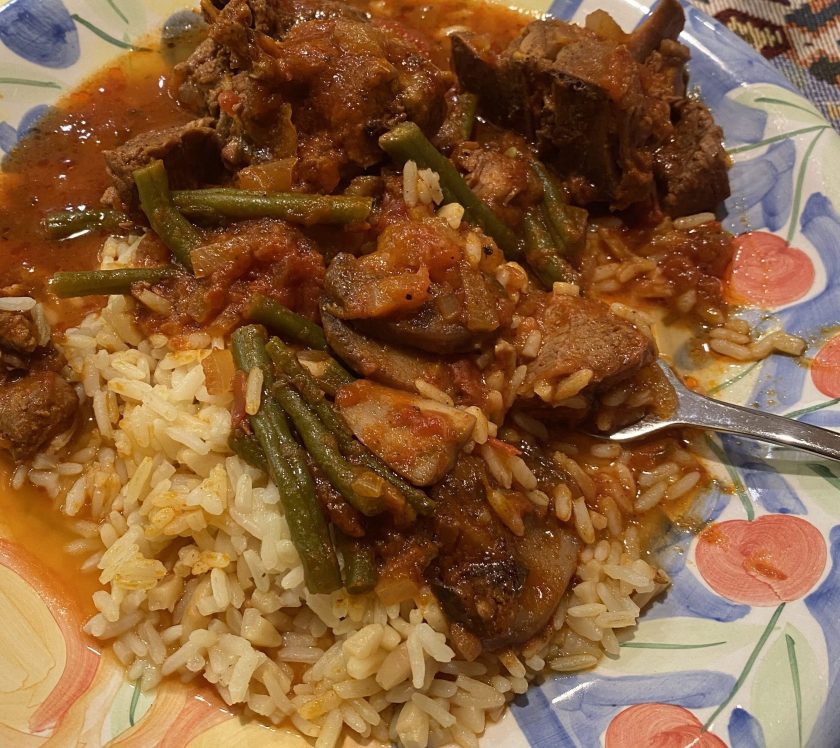
It didn’t take much convincing for my husband, he was in! And after deciding on an easy dish we were off to the supermarket to source the ingredients for our green bean and lamb stew. It seemed to be about the right skill level for us. “I don’t think we can mess this up,” I confidently said to my husband. 

Perhaps a little too simple, we thought, after returning from the store and surveying all the fixings. Hmm, is this going to be good, I mused? Of course, it was best that the recipe wasn’t too complicated, because there is nothing easy about the two of us working together in the kitchen… or anywhere for that matter.  We are not good collaborators and I don’t share well when it comes to my kitchen… because it is my kitchen after all! Let’s just say the stew wasn’t the only thing quietly simmering away. But as the delightful aroma started to waft through the air, all was forgiven.

And the results? The green been and lamb stew was amazing! Lip smacking good!! It just goes to remind me that some of the best things in life are the simple, uncomplicated things. The moment making stuff. The mundane stuff I guess, except there was NOTHING mundane about that stew! My Lebanese grandfather would have been proud!

If you are interested in the recipe or want to learn more about Maureen and her Lebanese Mediterranean Cuisine, I have attached a link to her website: https://maureenabood.com/